Monday, March 21, 2016

Focus Stacking

The Sony HX400V I have takes remarkable macro pictures when pared up with a macro filter. The small depth of field gets frustrating though for insect pictures. So, I recently started using photo shop to stack images.

The workflow is simple, take a burst of photos while slowly moving the camera closer and farther from the subject. It produces a bunch of photos like these:


On their own none of these are particularly impressive, but the batch of photos stack together well into the following photo:


This should work much better when my Sony a6300 comes in the mail, since it has a much larger buffer and with a macro lens better sharpness. Still, the amount photos are improved is quite impressive.


Saturday, March 5, 2016

Maui Snorkeling

I spend a few days in Maui. In that time there I made 551 iNaturalist submissions, 21 photo spheres,and the following video:


Thursday, March 3, 2016

iNaturalist at the Fullerton Arboretum.

The Fullerton Arboretum was looking for someone to run an iNaturalist workshop. Since I am the most active contributor within about twenty miles I volunteered.

The workshop will be at the Fullerton Arboretum on Saturday March 5th. Should make for an interesting experience as I have no idea what I am walking into.

Sunday, January 31, 2016

Mapping Relations

I decided to try and make a video showing my ancestry slowly moving towards California. Rather than showing the armies of cousins I have, this map just shows direct ancestors.

So far I haven't managed to finish making it into a video, but I did get pretty close. Here are maps showing the locations of all the ancestors I could locate from 1850 to 1940. Some of it is inferred, but most comes from census data.

The easiest way I found to map the points is Mapcustomizer.com. To get it into a video, I will probably need something more powerful though.

1850:


1860:


1870:


1880:


1900:


1910:


1920:


1930:


1940:


To be really interesting, it would need to go back to 1700 or so, but that data starts to get pretty speculative. I would be building the map based on two or three data points in a person's life. I also need a lot more information for the late 1800s to clearly show the westward migration in that era. I included almost all my second great grandparents in that list, but to adequately cover the late 1800s I need a lot more third and fourth great grandparents.

One thing this does show well is just how much the dust bowl impacted the family. In 1920 no ancestors were in California, in 1930, four ere in California, and in 1940 eight were in California. The only ones remaining outside the state were a few stragglers in Ohio and Missouri.

The last two Europeans also left the continent in the 1900-1920 era. This corresponds quite well to an era of mass immigration. 


Monday, December 14, 2015

Coyotes

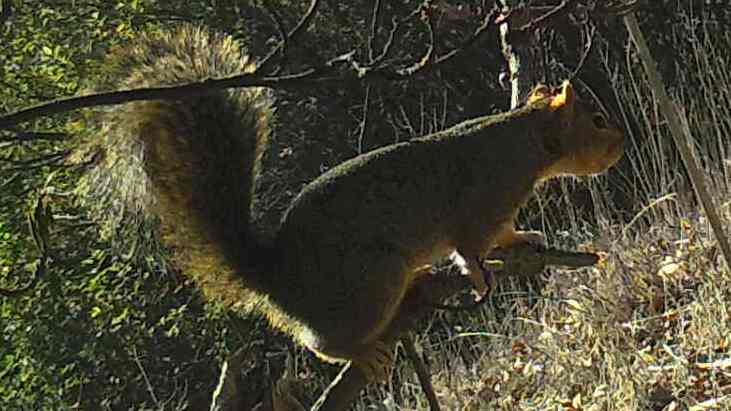
After another few days with the Primos 02 Trail Camera I have continued to have great luck. Placing it where I would not expect to find much it consistently finds animals. This weekend, it found a coyote four times, a skunk, and a squirrel:

Coyote:

Coyote:


Fox Squirrel:

The camera consistently produces identifiable pictures even of relatively small animals. It does trigger a lot on wind, but that sort of adds to the excitement of going through images. Since it can store 80,000 photos a few extra won't be an issue even if I send it off to the jungle for a month or two.

Rorabaugh Census Data

I decided to go download a bunch of old census data.

The earliest references I found which is plausibly my ancesstors were two entries in the census, one in the 1810 census for John Rorabaugh which is plausibly my 6th great grandfather . In that era it doesn't have much information beyond that he was in Scipio New York.


In the 1840 census there were two plausible entries, another for John Rorabaugh, and one for Nathan Rorabaugh which is plausibly my 6th great grandfather. Again these entries provide little information.


The 1850 census starts to get more interesting with an entry for Nathan Rohrbought and family. In this era, at least they give information about the names of all family members:


The 1860 census has the same, an entry for Nathan Rorabaugh and Family:


The 1870 census has an entry for John Rorebach and family. By this time they say profession and net worth.


In 1880 Nathan Rorabaugh shows up again, this time living only with his youngest son:


For some reason there was an 1885 census in Iowa which found John Rorabaw and family.


1900 through 1930 finds John W Rorabaugh and his quickly growing family. I was not able to find names for all his 21 children, but I at least found all the ones from his first wife:


Henry Emmett Rorabaugh shows up in the 1930 census. I particularly like his Occupation: "Odd Jobs" Industry: "Any Place" entries.


Thursday, December 10, 2015

Composite Images for Photo Spheres

I have started trying to use a camera instead of a cell phone to make photo spheres to submit to google maps. The basic idea is simple, take photos in every direction, then stick them into Microsoft Composite Image Editor. That can turn them into photo spheres relatively easily.

This is turning out to be a lot harder than a cell phone though. It is easy to miss a spot or two since you do not have feedback when you took photos in every direction. Also, the exposure to get the sky is not the same exposure to get the ground. So if you don't take a lot of care you end up with patches where one or the other look bad. For example, this photo sphere managed to do great on the pictures perpendicular to the sun. However into the sun, there is a big ugly patch where the exposure is wrong.