
I have never seen an art form where it is so easy to get an audience than google street view. So far I have submitted a total of 14 photo spheres. All have been submitted in the past five weeks and most are of hiking trails. From those 14 photospheres, I have got over 29,000 views!
It is surprisingly spotty, one has 15,000 views, another 5,000 views, while the rest are nowhere near those numbers. Google must advertise good ones in some form.
Sunday, November 15, 2015


Monday, October 12, 2015
Photo Spheres
I recently discovered that it is relatively easy to create photo spheres similar to what you see on Google Maps. This is using the Street View app for iPhones. Unfortunately, while they are really neat, they are not easy at all to share. The app makes your only option for sharing emailing a flat version or publishing to google maps. That very much limits what can be done with them. Right now it is not even easy to embed one of them into this blog!
Still, it is easy to create photo spheres of outdoor areas so I will probably make more while hiking. Here is one I took in Nashville.
Still, it is easy to create photo spheres of outdoor areas so I will probably make more while hiking. Here is one I took in Nashville.
Thursday, September 17, 2015
Mirrorless Underwater Setups
Within the next three years I will likely start putting together an underwater mirrorless camera setup. So I decided to price out a few options. They are all with the Sony E mount since my daughter has a camera on the same lens system.
Sony A7rII Camera with Nauticam Housing:
Sony A7II Camera and Meikon Housing:
Sony A7S Camera and Meikon Housing:
Sony A7SII Camera with Meikon Housing:
Full Sony a6000 setup with Ikelite housing:
Partial Sony a6000 setup with Ikelite Housing:
Sony A7S Camera and Meikon Housing
Sony A7rII Camera with Nauticam Housing:
- Sony A7rII Camera: $3,200
- NA-A7II Housing: $2,850
- Port for Kit Lens: $380
Sony A7II Camera and Meikon Housing:
- Sony A7II Camera: $2,000
- Meikon Housing: ~$300 (not yet released)
Sony A7S Camera and Meikon Housing:
- Sony A7S Camera: $2,500
- Meikon Housing for A7: $260
Sony A7SII Camera with Meikon Housing:
- Sony A7SII Camera: ~3,000 (not yet released)
- Meikon Housing: ~$300 (not yet released)
Full Sony a6000 setup with Ikelite housing:
- Sony a6000 Camera: $600
- Ikelite Housing: $1,050
- Sony 90mm Macro Lens: $1,100
- Port for Macro Lens: $250
- Extension for Macro Lens:$220
- AF35 Strobe:$430
- AF35 Second Strobe: $450
Partial Sony a6000 setup with Ikelite Housing:
- Sony a6000 Camera: $600
- Ikelite Housing: $1,050
- Port for Kit Lens: $350
- Zoom Sleeve: $25
Sony A7S Camera and Meikon Housing
- Sony a6000 Camera: $600
- Meikon Case for a6000:$250
Tuesday, September 15, 2015
College Scorecard
It has previously been very difficult to rank colleges on whether they are a financial disaster. Some reasonable looking schools give students lots of student loans and no more pay than they would get with simply a high school diploma.
The government just made it really easy to figure out whether schools are decent. Now there is a College Scorecard. They took income data from tax returns, so they have a very accurate picture of how much money college graduates make. They also assembled a lot of other information like cost, average debt levels, and graduation rate.
State schools in California still hold up rather well. The big name schools like UC Berkeley, UCLA, or UC Santa Barbara of course have great graduation rates, leave students with good incomes and are relatively cheap. The state college system does a much poorer job, but still is a solid system. For example Fresno State has above average graduation rates, above average incomes for graduates, and a cost which is way below average for in-state students.
A lot of the for profit schools rather predictably do horrible. University of Phoenix for example costs more than average and only about one in eight graduate. Surprisingly those who do graduate make decent income but would clearly have been better off at a state school.
The government just made it really easy to figure out whether schools are decent. Now there is a College Scorecard. They took income data from tax returns, so they have a very accurate picture of how much money college graduates make. They also assembled a lot of other information like cost, average debt levels, and graduation rate.
State schools in California still hold up rather well. The big name schools like UC Berkeley, UCLA, or UC Santa Barbara of course have great graduation rates, leave students with good incomes and are relatively cheap. The state college system does a much poorer job, but still is a solid system. For example Fresno State has above average graduation rates, above average incomes for graduates, and a cost which is way below average for in-state students.
A lot of the for profit schools rather predictably do horrible. University of Phoenix for example costs more than average and only about one in eight graduate. Surprisingly those who do graduate make decent income but would clearly have been better off at a state school.
Wednesday, August 26, 2015
iNaturalist Cameras
Being only a few days away from hitting 4,000 iNaturalist submissions, I have been thinking too much about my options for cameras to use for iNaturalist submissions. Here I am putting what I have learned in one place so when I have more money I can remember what my best options are.
Superzoom Cameras:
Superzooms are probably the best cameras for making iNaturalist submissions. Large zooms in a relatively small package lets them get pictures that you would otherwise miss. Even if a DSLR is your main camera, a pocket size superzoom to carry everywhere makes a lot of sense as a second camera. If they had GPS, a few of the 1" sensor superzoom cameras might make this list since they take nicer photos. Without GPS though they are too unwieldy to make sense for iNaturalist submissions with so many other good options out there. The following are the best superzoom cameras I could find for the application:
Superzooms won't do much good if taking pictures in a rough environment. It is not even possible to buy a commercial underwater housing for one. If taking pictures in less than ideal conditions, these cameras should be considered:
While all are a step up from a cell phone, the previously mentioned cameras do not take particularly good photos. If trying to create better images, while still keeping a small package mirrorless cameras might make sense. Unfortunately, the lack of GPS in any of these cameras means none are particularly great choices for iNaturalist submissions. One of these cameras might make sense if you want a high end underwater camera in a smaller package than a DSLR:
If you want photos with top of the line image quality and don't mind the increased cost and size, a DSLR can't be beat. Unlike mirrorless cameras many have built in GPS, or easily purchased adapters making them a good choice for nature photography. Like mirrorless cameras, they may require lens changes if you are switching between telephoto and macro photos. This causes them to miss some opportunities which a superzoom could easily catch. If pricing one out, make sure to see what it will cost to get a telephoto and macro lens to go with it as the cost of lenses often exceeds the price of the camera:
Superzoom Cameras:
Superzooms are probably the best cameras for making iNaturalist submissions. Large zooms in a relatively small package lets them get pictures that you would otherwise miss. Even if a DSLR is your main camera, a pocket size superzoom to carry everywhere makes a lot of sense as a second camera. If they had GPS, a few of the 1" sensor superzoom cameras might make this list since they take nicer photos. Without GPS though they are too unwieldy to make sense for iNaturalist submissions with so many other good options out there. The following are the best superzoom cameras I could find for the application:
- Nikon P900: For birds, reptiles and mammals, the 83X zoom on this camera makes it almost certainly the best camera out there. A telephoto lens with a DSLR can take better pictures, but only at the cost of really heavy lenses.
- Sony HX400V: This is the camera I have. It is probably the second best camera for birds, reptiles and mammals, but may be able to beat the P900 for insects.
- Sony HX90V: The previous cameras are too big. People look at you funny in certain social situations and I have even been known to attract police while taking pictures. The HX90V is able to do 70% of what the other two superzooms can do while remaining small enough to not stand out. Once again, the lack of GPS in some of the competition makes this the obvious choice of compact superzoom.
- Nikon Coolpix S9900: A somewhat cheaper compact superzoom that shares most features with the HX90V
Superzooms won't do much good if taking pictures in a rough environment. It is not even possible to buy a commercial underwater housing for one. If taking pictures in less than ideal conditions, these cameras should be considered:
- Olympus TG-4: Waterproof to 50 feet, amazing macro, and includes GPS. This is what I should have got instead of a Gopro as it is the best option for underwater photography at a reasonable price. It has little use for birds, reptiles, and mammals, but for insects and plants should do well enough.
- Nikon 1 AW1: A hardened version of a mirrorless camera, also the only mirrorless camera to include GPS. It claims to be waterproof, but every third review on Amazon seems to be someone complaining because it wasn't waterproof.
While all are a step up from a cell phone, the previously mentioned cameras do not take particularly good photos. If trying to create better images, while still keeping a small package mirrorless cameras might make sense. Unfortunately, the lack of GPS in any of these cameras means none are particularly great choices for iNaturalist submissions. One of these cameras might make sense if you want a high end underwater camera in a smaller package than a DSLR:
- A6000: One of the best cameras for underwater use, but lacks GPS.
- Olympus E-M1: One of the best cameras for underwater use, but lacks GPS.
- Olympus E-PL5: Generally good reviews for underwater use. The cheapest mirrorless systems for underwater use seem to be built around this camera. Again, lacks GPS.
- A7S: A very unusual camera, expensive and only 12 Megapixels. However its amazing low light capabilities would make for very good underwater use if willing to pay the steep prices for a housing. It is also likely to be a very good insect camera since in most conditions it can take photos with very fast shutter times without needing a flash. Again, lacks GPS.
If you want photos with top of the line image quality and don't mind the increased cost and size, a DSLR can't be beat. Unlike mirrorless cameras many have built in GPS, or easily purchased adapters making them a good choice for nature photography. Like mirrorless cameras, they may require lens changes if you are switching between telephoto and macro photos. This causes them to miss some opportunities which a superzoom could easily catch. If pricing one out, make sure to see what it will cost to get a telephoto and macro lens to go with it as the cost of lenses often exceeds the price of the camera:
- Canon EOS 7D Mark II: Mid range DSLR with GPS. Since it has a variety of options for underwater housings it is likely a good choice for underwater photography.
- Nikon 7200: Mid range DSLR with GPS modules readily available. Since it has a variety of options for underwater housings it is likely a good choice for underwater photography.
- Sony A99V: Mid range DSLR with GPS. Lacks good options for underwater photography but would likely be fine for any photography on land.
- Pentax K-3II: Mid range DSLR with GPS. Lacks good options for underwater photography but would likely be fine for any photography on land.
- Canon EOS 1DX: High end DSLR, known as the best wildlife camera in the Canon line.
- Nikon D4S: High end DSLR. If you are not sure whether you want to buy a car or a camera this is probably the one for you.
Tuesday, August 25, 2015
Laguna Pictures
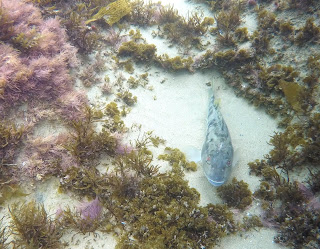
I took more pictures in Laguna last weekend. Conditions were about ideal, 25 foot visibility in 70 degree water. The Gopro Hero 4 Black with a Sidekick Duo therefore did do quite a bit better. For a few pictures like the Lobster, the Sidekick Duo really was necessary to have any hope of getting a decent shot.




Saturday, August 22, 2015
A Year of Weights
Last September, I bought a scale. At some point I decided that weighing myself regularly would be about the best strategy to lose weight I could find. Here is a few days shy of one year of records. I weigh myself at the same time daily to try to confirm that the measures are meaningful.
 After about three months of my tactic failing, I got annoyed with the whole thing, spent about two months being fairly hungry, and lost a bit more than ten pounds. This chart understates it since I was at about 195 for a couple years before this.
From what I hear it takes a year or two at a lower weight before your body stops trying to get back to the old weight. So we will see if I can hold this.
After about three months of my tactic failing, I got annoyed with the whole thing, spent about two months being fairly hungry, and lost a bit more than ten pounds. This chart understates it since I was at about 195 for a couple years before this.From what I hear it takes a year or two at a lower weight before your body stops trying to get back to the old weight. So we will see if I can hold this.
Subscribe to:
Posts (Atom)